Math of Mozart

Wolfgang Amadeus Mozart was a prolific composer of the Classical period. He was one of the greatest geniuses the world of music has seen. While the prodigious artist lived a short life, he left a long-lasting impression in the field of his interest. Along with being a musical polymath, Mozart was also a true mathematical genius. As his sister, Maria Anna Mozart said, he used to fill the walls of their house with numbers. But did his fascination with math have an influence on his music?
This article will take a look at how Mozart used math in his music, specifically, the Fibonacci Sequence.
The Fibonacci Sequence is one of the most famous formulas in mathematics. Each number in this sequence is the sum of the two numbers that precede it.

The ratio for this sequence is 1.618. This is what some people call ‘The Divine Proportion’ or ‘The Golden Ratio’. When you make squares out of those values, it makes a nice-looking spiral:
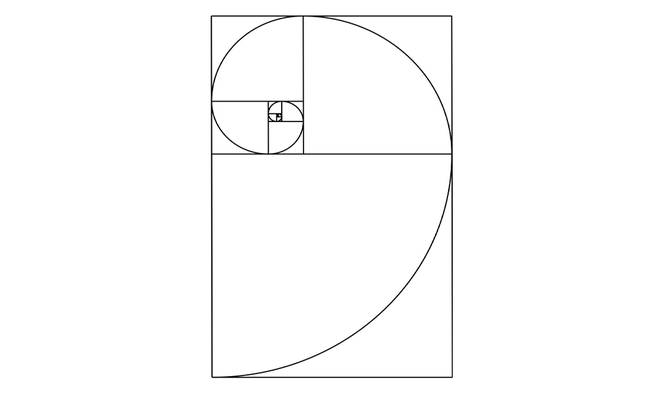
This sequence has popped up in a lot of music composed by Mozart. He used numbers of the Fibonacci sequence to allot time to different sections of his music. This is especially prominent in Sonata no. 1 in C Major. The first two sections of that piece, known as the exposition and recapitulation consist of 38 and 62 measures respectively. Adding 38 and 62 gives us 100. Keeping in mind the Golden Ratio, we notice that there is no better way to divide 100 other than 38 and 62. 62 divided by 38 gives us a number extremely close to the Golden Ratio.
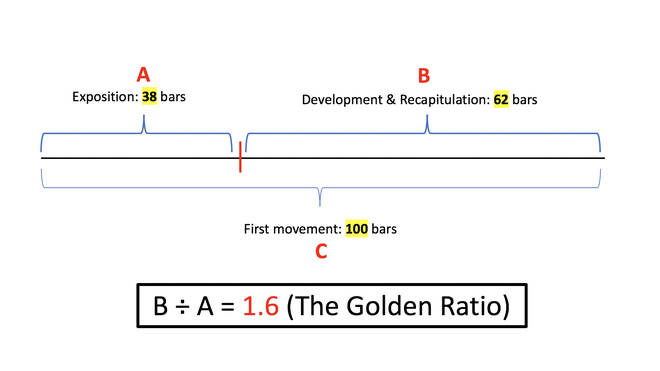
Even though this is far from being a certain proof that Mozart consciously relied on mathematical principles for all his compositions, it tells us how we humans tend to seek a “natural order” in everything we do. It shows how musicians, even though unconscious about it, incorporate nature’s order in their music.
Symmetry in Bach’s Music

Johann Sebastian Bach was a phenomenal composer who is revered through the ages for his work’s musical complexities and stylistic innovations. While his compositions are the free creations of a genius, they have a fundamentally mathematical basis.
In this article, we are going to understand how Bach used symmetry to create intricate melodies.
First, let’s understand how symmetry works. In very basic terms, symmetry is when a shape becomes exactly like another when it is moved in some way. The movement could be in any way possible. It could be by rotating, flipping or sliding it.
Now, let’s apply this concept to Bach’s music. Bach would first create a short musical phrase that he would use throughout the entire song. This phrase would usually be a special characteristic of the music. This phrase is known as the motif. Bach would then go on to make two variations of the motif. The first variation he would make is by laterally inverting the motif. This would result in a new musical phrase that has a new and different sound. It is known as the inversion. The second variation he would make is by flipping the motif along the horizontal axis. This variation results in a retrograde.
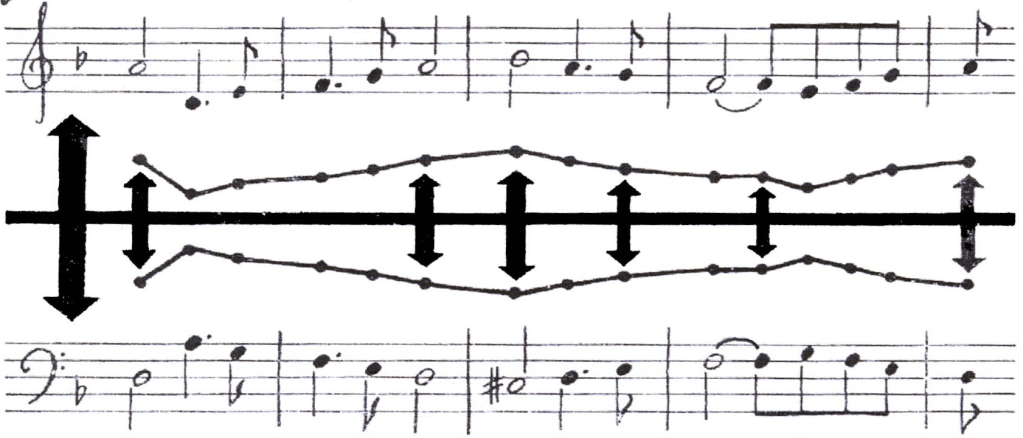
There is a clear symmetry between all the phrases. Rotating the motif by 180o results in the retrograde. Flipping the motif results in the inversion. It was by this basic change, that Bach got the ability to enrich his music in a very sophisticated manner. Bach gave us a basic pattern as the motif, and that was enough to hold on to. It gave us an expectation as to what was to come next. But to prevent boredom, he varied it, and thus managed to keep us on our toes. It is quite impressive, how Bach managed to deliver such an intricate and beautiful song, based on a single idea. Good music contains the right balance of predictability and surprise, and Bach’s music does the same too.
 The Math of Music